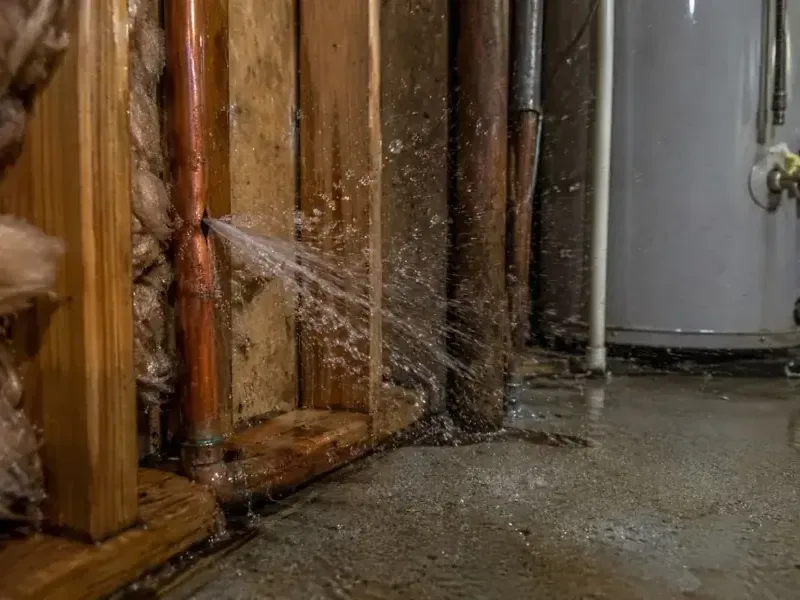
A water main break rarely floods a house on its own. What it does is change the pressure in every pipe attached to the system, and when pressure comes back, weak points inside a home can show themselves.
Key takeaways
- In July 2017 a water main break under Highway 212 opened a large sinkhole and cut pressure to about 1,500 homes and businesses.
- Sunrise Water Authority issued a boil water notice after that break.
- When pressure returns, open taps, running toilets and weak fittings are the first things to check inside.
- A boil notice affects drinking, cooking and ice, not the question of whether a leak needs repair.
- Water that reaches floors from a failed fitting should be stopped at the shutoff and then removed.
What happened on Highway 212 in 2017
Damascus is an unincorporated community and census-designated place in Clackamas County (see the Damascus town page), and it lies along Oregon Route 212, also called Highway 212. In July 2017 a water main break under that road opened a large sinkhole.
Deputies closed Highway 212 after the break and later reopened one lane with a flagger directing traffic. About 1,500 homes and businesses lost water pressure, and a boil water notice was issued.
The Rock Creek watershed and the Clackamas County Fire District #1 service area also cover the community, which shows how many agencies share the same roads and utilities. Fire Station 19 sits in the community, with Station 7 Pleasant Valley and Station 14 Boring also responding.
Who supplies the water and what a boil notice means
Sunrise Water Authority provides water service to Happy Valley, Damascus and Clackamas County. That agency issued the notice after the 2017 break, naming customers on or near Wiese Rd., Bohna Park and Alder Springs, among other streets.
A boil notice is a precaution about drinking water. It says nothing about whether a pipe inside a house is leaking, so the two questions are handled separately.
- Boil water used for drinking, brushing teeth, making ice and cooking until the notice is lifted.
- Water for washing floors and clothes follows the notice's own directions.
- Plumbing repairs are not delayed by a notice.
What low pressure does to plumbing inside a house
When a main loses pressure, water in a house does not simply stop. Taps run weakly, toilets fill slowly, and air can get into the pipes.
When the repair is finished and the main is refilled, pressure and air move through the system together. Air pockets can make faucets spit, and a surge can find a worn washer, a loose supply hose or an aging valve.
None of this means a house will leak. It means a house with an existing weak spot is more likely to show it at that moment, and that the first minutes after the water returns are a good time to look around.
- Faucets left open during the outage will begin flowing again, sometimes onto a counter or into a sink with a stopped drain.
- Toilets with worn flappers may run once the tank refills.
- Washing machine hoses and ice maker lines may spray if they were already weak.
- A water heater may refill and release air through a relief valve.
A checklist for when pressure returns
A short walk through the house after the water is restored can catch a small leak before it becomes a flood.
Before turning things back on
Close every tap that was left open during the outage. Flip off the washing machine and dishwasher so they do not fill unattended when water returns.
Ice makers and water filters on refrigerators deserve a look too, since their thin tubing sits behind the appliance where a drip can run for days.
- Close taps and fixtures opened during the outage.
- Check under sinks and behind toilets with a flashlight.
- Look at the water heater and its pan or floor for moisture.
- Listen for hissing or running water when everything is off.
If a leak is found
Closing the main shutoff valve stops the water. Knowing where that valve is before an emergency saves time.
- Photograph the wet area and the damaged fitting.
- Move belongings out of the water and lift rugs off wet floors.
- Mop or wet vacuum small amounts; call for pumps if water is deep.
- Keep the failed part for the plumber and the insurer.
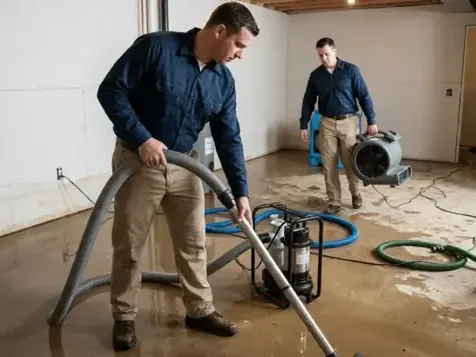
When standing water needs removal
A small spill on a tile floor is a mopping job. Water that has spread under cabinets, into carpet or toward walls needs professional water extraction.
The reason is where the water goes next. Drywall wicks water upward, flooring traps it, and a floor that looks dry can still hold moisture in the pad or subfloor.
Water under a vinyl floor is a common surprise. The surface looks fine, but the layer below holds moisture, and the edges curl as it dries slowly.
- Water has spread beyond one small area of the floor.
- Carpet or pad feels wet underfoot.
- A wall base or cabinet kick looks darker than the rest.
- Water is dripping through a ceiling below the leak.
If a fitting fails and floods a room
A burst or failed supply fitting can release a lot of water quickly. The cleanup then follows the same path as other burst pipe water damage: stop the source, remove the water, open wet areas and dry them.
Documentation counts in this type of event. The date of the outage, the notice and the date of the leak can all help show how the damage started.
Records that help after an outage
An outage of this kind affects many households at once, so records tied to the date help sort out which damage came from which event.
A short note with the date the pressure dropped, the date it returned and any leaks found is enough. Photos of fixtures, floors and the water heater taken before and after add to that record.
If water reached the floor, the crew's moisture readings help show how far it traveled. Owners can ask for copies when the job closes, and they can pass them to an insurer.
- Write the time pressure dropped and when it returned.
- Photograph fixtures before and after.
- Save any notice from the water provider.
- Keep receipts for bottled water and repairs.
Habits that reduce risk in any outage
The 2017 event shows how fast a community can lose pressure. A few habits at home turn an outage into a minor event.
Sunrise Water Authority reports that its 2025 water met or exceeded all federal and state drinking water standards, which is a separate matter from outages. The risk after a main break is mostly inside the house, not in the supply.
- Know where the main shutoff valve is and test that it turns.
- Keep a flashlight and towels near the water heater and washer.
- Turn off the washer and dishwasher during a known outage.
- Replace old rubber hoses with braided ones.
Questions
How many homes lost pressure in the 2017 Damascus break?
About 1,500 homes and businesses lost water pressure, and a boil water notice was issued.
Who issued the boil water notice?
Sunrise Water Authority, which provides water service to Happy Valley, Damascus and Clackamas County.
Does a boil notice mean a house is leaking?
No. It is a drinking water precaution. Leaks inside a house are found by checking fixtures and listening for water when everything is off.
What should be checked first when pressure comes back?
Taps left open, toilets, washing machine hoses and the area around the water heater.
When does a leak need professional water removal?
When water has spread under cabinets, into carpet or toward walls, because those materials hold water out of sight.