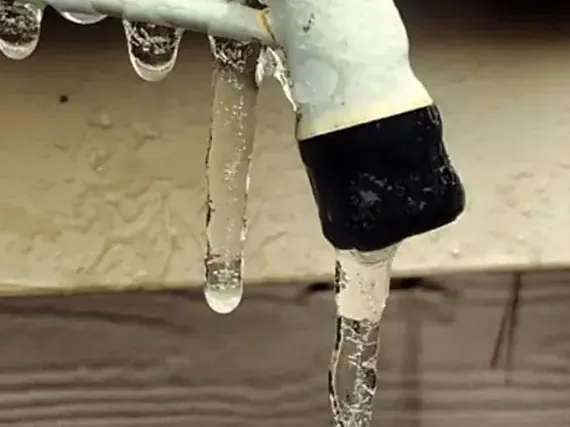
Happy Valley is known for rain more than ice, with an average of 48 inches a year. That makes a cold snap easy to forget until the pipes remind everyone. Freezing weather is the main risk for pipes in unheated spaces, and the damage comes when the ice melts.
Key takeaways
- Portland area water bureau advice says pipes can freeze or break at or below freezing.
- Letting faucets drip and knowing where the shutoff valve is are the two simplest steps.
- The flood usually starts at the thaw, when a split pipe releases water.
- If a pipe has split, shut off the main supply first, then remove water and dry.
- A frozen pipe that has not yet burst should be thawed gently, not with flame.
Why a rainy city still has frozen pipes
Cold snaps do not come often, but when they do, homes built for mild winters are not always ready. Pipes in garages, exterior walls and crawl spaces are the first to feel it.
The February 2021 snow and ice storm cut power to more than half a million Oregon homes and businesses, a recent reminder that winter weather in the region can reach well beyond a light frost.
The exposed places are easy to name. Garages, crawl spaces, attics, outdoor hose bibs and pipes inside exterior walls all sit outside the heated envelope.
Advice before a freeze
The Portland area water bureau says pipes can freeze or break at or below freezing, and its advice is to let faucets drip and to know where the shutoff valve is. Both steps take little time.
Let faucets drip
Moving water is harder to freeze, and a small drip relieves pressure between the ice and the faucet. The faucets to choose are the ones on exterior walls or at the ends of pipe runs.
- Open the cold tap on sinks along exterior walls to a slow drip.
- Open cabinet doors under sinks to let room air reach the pipes.
- Keep the heat on and set at a steady level, even when away.
Know the shutoff
The main shutoff valve is the key to a small problem. Every adult in the house should know where it is and how it turns.
- Test the valve once a year so it does not seize.
- Label it with a tag if it is hard to spot.
- Know where the water heater shutoff and the outdoor hose bib shutoff are.
What happens at the thaw
Ice expands inside a pipe and can split the pipe wall or a fitting. The split often stays sealed by ice until the temperature rises.
When it warms, the ice melts and water pours from the break. The owner may be away at work or asleep, and a split pipe on a full pressure supply can wet several rooms.
A pipe does not need to reach a deep freeze for trouble. A few hours below freezing in a still, cold space can be enough, which is why the advice about dripping starts when the forecast does.
- A sudden drop in water pressure or a hissing sound after a freeze.
- Wet drywall, stained ceilings or water dripping from a light fixture.
- A rug or floor that is wet near an exterior wall.
- A faucet that gives no water when the others do.
Steps when a pipe has split
The first goal is to stop the water. The second is to keep it from spreading.
- Shut off the main water supply.
- Switch off power to wet areas if water is near outlets or lights.
- Open taps to drain remaining water from the system.
- Move belongings out of the water and photograph the damage.
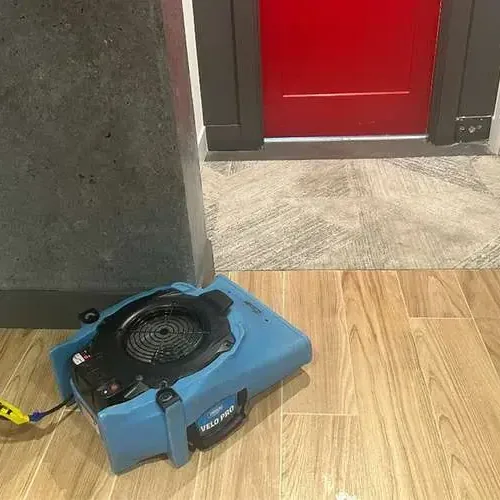
Removal and drying after the burst
A split pipe delivers clean water at first, which is why quick work can save more materials. The job for burst pipe water damage starts by removing the water and opening wet wall and ceiling areas.
Frozen pipes also carry a particular risk. The break is often in a wall or a crawl space, so the damage may be out of view.
The frozen pipe water damage work includes checking behind walls and under floors with a moisture meter.
The work also covers the room below the break, where water extraction removes whatever pooled. Water from a split pipe in an upstairs wall can run through the floor into a ceiling, so wet areas are traced from the break downward.
- Pumps and wet vacuums take out standing water.
- Wet insulation and low drywall are removed.
- Air movers and dehumidifiers dry the framing for several days.
- Readings are taken until the wood returns to normal.
Cold weather habits that help
Preparation is mostly small and cheap. It comes down to a few actions before a hard freeze arrives.
Hoses are disconnected from outdoor spigots, so water does not sit in the pipe through the cold. Crawl space vents and garage doors are closed, and exposed pipes in unheated spaces are wrapped.
People who plan to be away should ask a neighbor or relative to check the house, or leave the heat on at a steady level.
- Disconnect and drain garden hoses.
- Wrap exposed pipes in unheated spaces.
- Close crawl space vents and garage doors in a freeze.
- Leave heat on during a trip.
- Ask someone to check the house if the cold lasts.
Why it helps that the homes are mostly newer
Most Happy Valley homes standing today were built after 2000, and 78.5 percent of occupied homes are owner-occupied. Newer construction does not make a pipe freeze-proof, but it does mean owners often have records of the build and can find the shutoff and the plumbing plans.
A home that sits empty during a cold week, such as one belonging to an owner on a trip, carries the highest risk because no one is there to notice.
Thawing a frozen pipe that has not burst
If a faucet gives no water and the pipe looks intact, gentle heat can help. Open the faucet first so melting water has somewhere to go.
- Use a hair dryer or warm towels, not a torch or open flame.
- Start at the faucet end and work toward the frozen section.
- If the pipe is behind a wall or cannot be reached, call a plumber.
- Watch for leaks as the pipe thaws.
Questions
At what temperature can pipes freeze?
The Portland area water bureau says pipes can freeze or break at or below freezing.
Does dripping a faucet really help?
It keeps water moving and relieves pressure. The bureau's advice is to let faucets drip during a freeze.
Where should the shutoff valve be?
Where the main supply enters the house, often near the water heater, a garage wall or a utility room. Each home differs, so owners should find theirs before a freeze.
Why does the flood start at the thaw?
Ice can hold a split pipe closed. When the ice melts, water pours out of the break.
Can a frozen pipe be thawed with a torch?
No. A torch or open flame can start a fire or damage the pipe. A hair dryer or warm towels are safer.